My Problematic Favourites
Thoughts on Lynne Reid Banks and Roald Dahl
Please note that this post was written and published in 2024 for a paid readership.
Holy hen’s teeth, there were two media mentions of children’s literature over the weekend (in UK papers and about British authors — a detail I mention for my majority Australian readership).
One was the obituary of Lynne Reid Banks, who has died at the age of 94. She was the author of the famous children’s book The Indian in the Cupboard, which I haven’t read, but perhaps even better known for the 1960 novel The L-Shaped Room, which I’d like to talk about in the context of problematic favourites.
The other mention involves a series of Roald Dahl follow-up novels by various British children’s authors and illustrators — more specifically an apology issued over an ableist slur in the marketing of one of them.
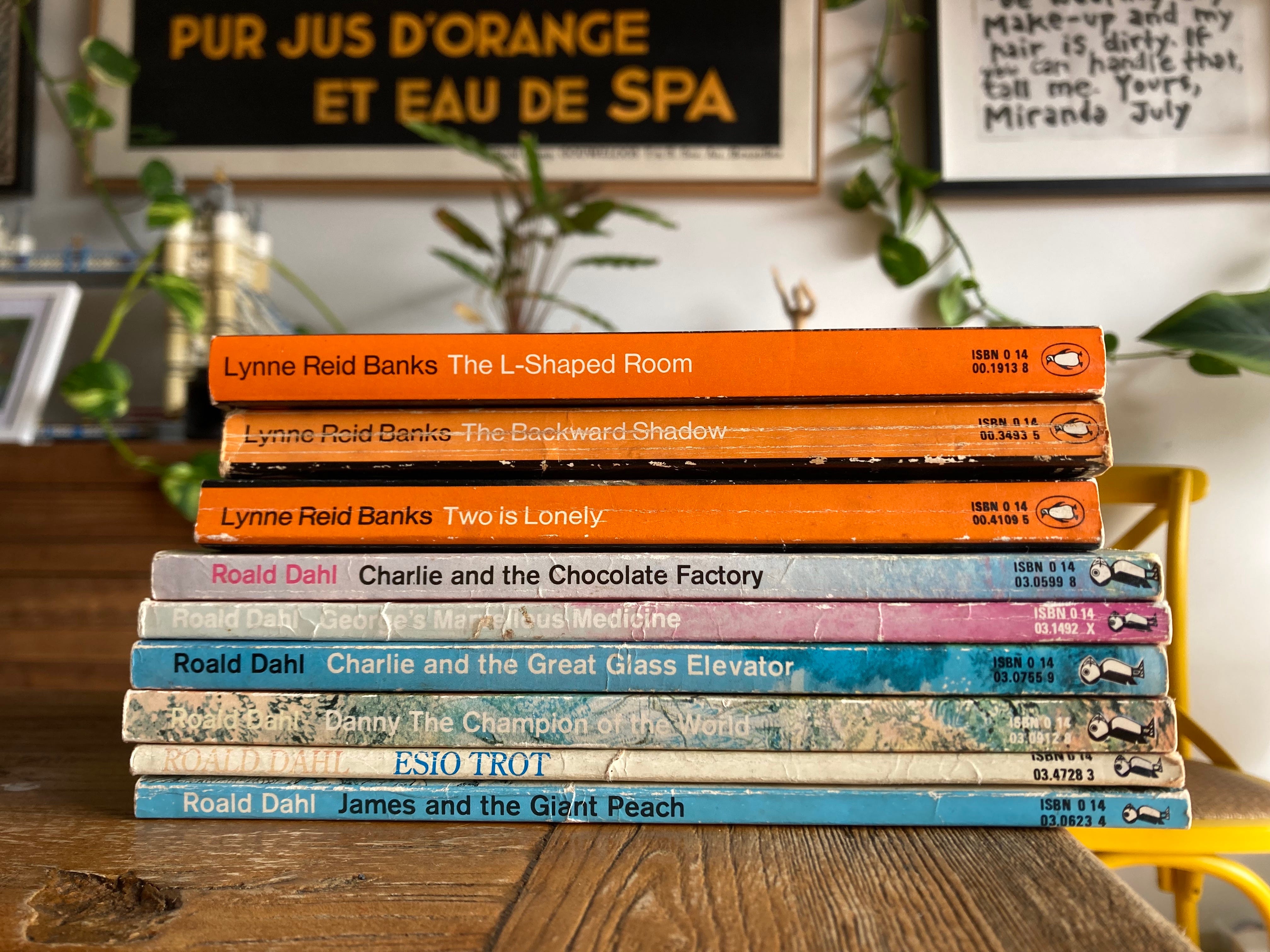
The L-Shaped Room is the first-person account of Jane, a young, unmarried, pregnant woman who is turned out of home by her father. She rents a flea-infested room in Fulham, back then a working-class suburb, and befriends her interesting neighbours. I read it in the early nineties, when social norms had moved on a great deal, but I was fresh from Catholic school, where social norms could go hang. I fell in love with it. For years, foggy on the details, I carried the memory of reading it and my vision of Jane’s bedsit. I used the phrase “the l-shaped room” in one of my children’s books — to describe the library in The Goodbye Year — privately remembering the book again.
“My room was five flights up in one of those gone-to-seed houses in Fulham, all dark brown wallpaper inside and peeling paint outside. On every second landing was a chipped sink with one tap and an old ink-written notice which said ‘Don’t Leave Tap Driping’. The landing lights were the sort that go out before you reach the next one. There were a couple of prostitutes in the basement; the landlady had been quite open about them. She’d pointed out that there was even an advantage to having them there, namely that nobody asked questions about anybody. She dropped her eyes as she said that. Not out of modesty. She was looking to see if I were pregnant.”
When I tried to re-read The L-Shaped Room recently, I got as far as page 12 and Jane’s recollection of a gay actor she once knew before I started to think, uh-oh . . . And then I read a few more pages to Jane’s first meeting of her Jewish neighbour, when I thought, did I really think this was okay? . . . And a further few pages to the description of Jane’s black jazz-player neighbour, when I finally closed the book. This I’d been carrying around as my favourite?
I didn’t abandon my re-read because I’m shocked or surprised by racism, anti-semitism and homophobia in British literature of the first half of the twentieth century, of course not. It was because this novel had meant something to me in my youth — I needed to sit with the fact that, back then, I’d skimmed past these descriptions. That in spite of them I’d felt connected to Jane. There I was thinking I’d been the righteous one in my family — the dinner table trouble-maker, they called me, who’d tell my grandparents off for saying “poof” or my mum for calling someone “common”.
But here was the evidence in black-and-yellowing-paper: when it came to fiction, no slur was going to get in the way of me and a story about a young white woman and her young white woman problems.
Lynne Reid Banks was shocked by The L-Shaped Room when she re-read it in the lead up to a radio interview she did in 2010 for the BBC, fifty years after its publication, when she was 81.
“When I re-read the book for this occasion, it was like reading a book written not only by another person but about a completely different era,” said Banks. “I mean it might as well have been 100 years ago as fifty. On one side I could remember writing it . . . but there are things in the book I found quite startling.”
“Like what?” asked the interviewer.
“Never you mind,” Banks replied. “I’m not going to throw myself to the lions. But I wouldn’t write as I did then, now. PC has intervened, and thank god it has — PC is nothing more or less than making you examine your bigotries and not hurt people’s feelings.”
I’ve held onto my old seventies editions, with their cracked orange spines — I can think about the fact that I “wouldn’t read as I did then, now”; I can reflect on the social issues of today and wonder how we’ll be talking about those in another fifty years.
When it comes to children’s books and the various money-making schemes of children’s publishers, I take a different view. I see recent efforts to edit and modernise children’s classics as cynical and misguided, wholly driven by money but disguised as an exercise in progression and ‘correction’.
Should we edit books, while the author is alive, if we find harmful errors? Absolutely.
Should we contrive to conceal the intentions of a long-dead author in order to manufacture a brand new generation of fans for his work? Hell no. Even if it means the children’s publisher makes a lot of money and that “benefits everyone”? Still hell no.
I was a fan of Roald Dahl’s work as a kid. I’m still a fan of much of it. I’ve used his short stories to engage high-school boys who hadn’t picked up a book or enjoyed fiction for years. I think he was brilliant, and unpleasant, in several ways. But I wish we’d leave the publishing past in the past when it comes to long-dead, problematic authors.
Puffin are due to publish a new series in which children’s authors and illustrators create follow-ups to various Dahl books including The Twits, Matilda, and Charlie and the Chocolate Factory. Coming to a bookstore near you soon will be The Twits Next Door, and Charlie and the Christmas Factory, among others.
The first problem arose when a promotional video was released in which the creators referred to a “glass eye” as making Mrs Twit even more disgusting and revolting. This was widely criticised as ableist, including by the Royal National Institute for Blind People, who said: “When there’s positive representation of disabilities in children’s books, a truly wonderful thing happens – children with disabilities feel seen and heard, and their friends and classmates treat everyone the same,” it said. “There is nothing at all revolting about prosthetic eyes, we think they’re brilliant.”
Inevitably, an apology was issued — the creators felt terrible, they didn’t mean it, etc etc etc, and presumably now it’s business as usual, minus the formerly revolting and disgusting glass eye . . .
This comes just a year after the whole “Roald Dahl books are being edited for nastiness” story.

The problem is that Dahl’s work encourages this kind of meanness and calls it humour. People who love him don’t seem to be able to stop themselves from emulating that. Take David Walliams, for example, whose books are full of the same “horrible” humour, and written by (maybe written by) a similarly problematic man. When we criticise humour of this variety, we’re called humourless, un-fun, we’re spoiling things for everyone, as if there is no other way to be funny than bitchy othering.
Excuse me, I am very fun and so are all my friends. Truly, I even think you can be wonderfully Dahl-esque without stooping to that unkind humour. Huda & Me by H. Hayek, for example, has something about it that reminded me of the forthright fun of Dahl’s books but absolutely none of the prejudice. And there are other children’s writers the world over who are incredibly funny, and fun, whose books invite all children to enjoy them, without exclusion.
If we could only stop giving dated children’s classics the equivalent of Ozempic and a face lift — let them grow old disgracefully, from the paper they're printed on to the old ideas they contain — we could redirect the marketing funds so that readers can actually FIND these new, funny authors.
We should stop restyling the past and start investing in the classics of the future.


I groaned when I saw they were making 'new' RD books. Why?? Why not invest in NEW authors instead? Then i saw the list of well-respected contemporary children's authors who are involved in the project and I wondered if i was just being mean-spirited. If they get to have fun and make some money then maybe it's ok. But still, I'd rather publishers were promoting those authors' OWN BOOKS. There, I said it.
I remember being amazed by all the racism and homophobia in L-Shaped Room when I read it as an adult, but also thinking it was probably an accurate depiction of 1960s England. That interview with Lynne Reid Banks sounds great - she seems like a thoughtful person who evolved as society did.
Huda and Me was a fun read, but did it really have "none of the prejudice of Dahl"? It seemed to me to be very strongly in favour of conservative patriarchal beliefs, just as Dahl was. All the male characters were strong and compassionate and morally right, while all the post-puberty female characters baked cupcakes and did beauty treatments and had babies. Akeal and his dad were heroes, but Akeal's mum was completely passive, even when her children were in danger, and the villains (a crazy baby kidnapper and an ice-hearted, child-hating flight attendant) were all single, childless women. I guess as readers we tend to notice the 'prejudices' that affect us. Having said that, I do support true diversity in publishing, which includes authors who have different belief systems to me! No book could ever be inclusive of every possible reader, so we need lots of books by lots of different voices.