The Secret Garden Game
A meditation for (some) writers
“When Mary Lennox was sent to Misselthwaite Manor to live with her uncle everybody said she was the most disagreeable-looking child ever seen. It was true, too . . . by the time she was six years old she was as tyrannical and selfish a little pig as ever lived.”
— from The Secret Garden by Frances Hodgson Burnett
I was in Brisbane this week for a series of talks to high school students — a prospect I was both dreading and thankful for (that common formula for the shy but ambitious writer).
I’ve written before about my anxiety in the lead-up to any and all public speaking, the main characteristics being weeks of mental bargaining, over-preparation, irritability, psychological self-flogging, and a torturous sleepless night before the event.
Honestly, I’m a riot.
So it was no surprise to find myself wide awake at 4am the morning of my first day in Brisbane. Since I was sharing a small apartment with an author I’d only just met, getting up to walk about and reset myself — as they say you ought to when you’ve been lying awake for hours — was not an option, and the windowless bedroom was shin-bangingly small. Blearily, I grabbed my phone, typed “meditation sleep fast” into podcasts (probably more like mwsirayion dleep fsdt because I didn’t have my glasses on), and lay comfortably on my back, prepared to be mind-controlled into unconsciousness by a wise woman.
A man’s voice piped up. Damn, I thought, I’d have to search for another episode, exposing myself to more sleep-defying blue light in the process — meaning no disrespect but I have a strong association with women when therapy or relaxation techniques are concerned. But then, recalling the reassuring male anaesthetist who put me to sleep for surgery a few months ago — how he’d gently counted me down to darkness, albeit with a carefully measured cocktail of drugs — I kept listening.
The podcast began with the usual spiel about lying comfortably, ready for sleep. There was breath work, a body scan: so far so good. But all of a sudden he was talking about gratitude. Apparently that was the theme of this whole meditation. I sighed audibly into the small, airless room. Mate, I don’t have time for gratitude! I have to be up in three hours to speak to a hundred teenagers!
Nevertheless, I persisted — perhaps counting blessings was more useful than counting sheep. He talked me through some obvious ones first:
Be grateful for your loved ones (I am, I am, I am, I thought, my children’s smiling faces becoming drifting balloons in my mind’s eye).
Be grateful for your safety (well, I’ve only ever seen one person actually die on stage, I thought, imagining the day ahead, so that’s the worst case scenario probably ruled out).
Be grateful for your heartbeat (sure, I thought, I mean, I have an arrhythmia, but what artist doesn’t want to live by an irregular beat?).
Then he killed it.
“Be grateful for utilities companies.”
I’m sorry, be grateful to who now?
“Gas companies,” he continued. “Electricity, water, telecommunications . . .”
I switched him off and felt more awake than I’d felt my entire life. So that was that. I gave up on sleep. Inevitably, I survived the day — as I always do, as I knew I would, as old-mate anxiety refuses to accept — and thus the cycle of accepting gigs, dreading gigs, and kind of enjoying gigs once they’re happening, continues.
Despite not being grateful for corrupt multi-billionaire utilities companies, my days in Brisbane did start me thinking about what a midlist writer might be grateful for. What treasures are we storing without even knowing it? You know, considering the fact that we’re unable to be grateful for financial security, wide popularity, or being “heard of” by any of the strangers who ask “would I have heard of you?” at parties.
As my list grew, I felt a little proud of myself, even a little smug — look at me! I thought, making so much lemonade! And inevitably my well-read inner-cynic piped up, “What a Pollyanna”. To refresh your memory: Pollyanna is the 1913 children’s book by American author Eleanor H. Porter, about an orphan girl sent to live with her austere aunt, who gets through the difficulties of life by playing “The Glad Game”, and lifts an entire town out of misery by teaching everyone else how to play it. (They teach her right back when she falls out of a window and can’t walk any more.)
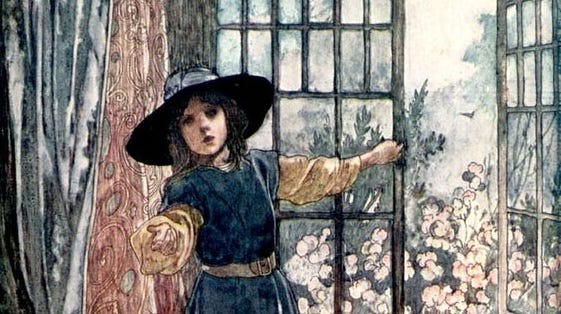
But I have never identified with Pollyanna, I’m afraid. I see myself far more in Mary Lennox of The Secret Garden, published two years earlier — a disagreeable, tyrannical, curious child who happens upon a place of wonder and is imaginative and ambitious enough to see it for what it could be.
So that’s what I’m calling this game of noticing what a writer like me must be grateful for — the secret garden game, where you find that good things grow over time, unnoticed, wild and tangled, until you find the door and the will to make sense of what’s inside.
I’m grateful that I’m free enough to be a risk-taker, compelled to write the thing I want to write, the way I want to write it (long may this give off a trance-inducing scent to publishers . . . )
But resourceful enough that no manuscript has been a waste of time, even if I haven’t published it. I know how to break a thing up for parts and use them to make a new story
I’m grateful that I’m sanguine enough to get over the inevitable rejections (and that my journey involved some major ones early on)
But gloomy enough not to flog a dead horse
I’m grateful that I’m skeptical enough to spot a publishing pot-hole, misconception or false prophet a mile away
But unjaded enough to believe that there is still no greater joy than to be in pursuit of a story
And I’ll keep looking around this garden.
A related note about The Secret Garden to finish. Although this “classic” sold pretty well when it was first published in 1911, it fell into obscurity for several decades. Even while children’s literature experienced blooming critical attention, The Secret Garden was ignored — how oddly fitting. Children and librarians brought it back to life by continuing to love it and pass it on. By the Sixties it had made a comeback, so much so that when it went out of copyright, several publishers were mad keen to produce their own edition.
And they still are.
Thank you for reading Voracious.


those illustrations are beautiful! I have had a similar Brisbane hotel early morning meditation malaise. I am grateful always for coffee.